
Extract from Chapter 9: Challenges of the job search – identity
From: Making Sense of My Unemployment (M.G. Ramirez-Ocando)
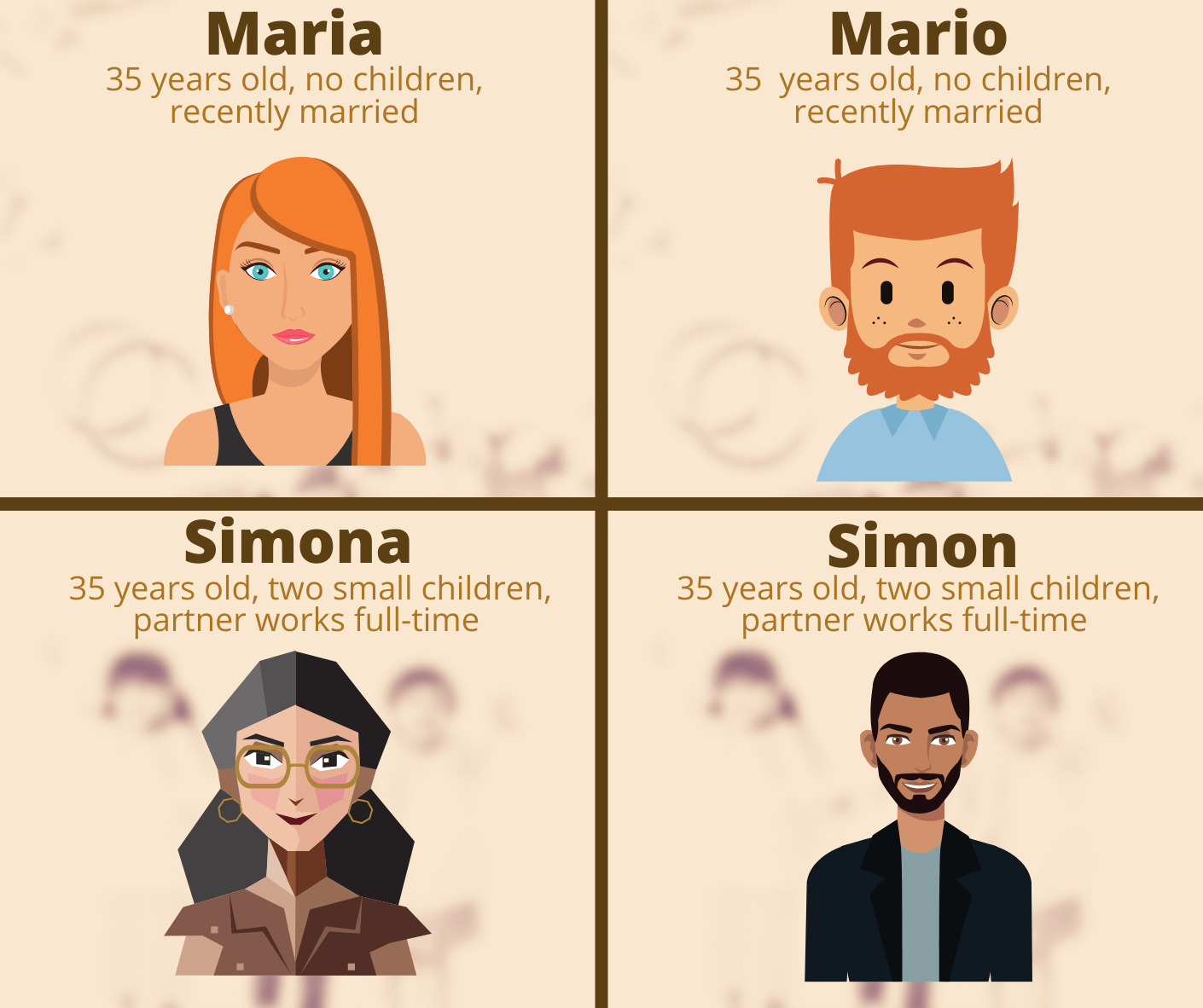
Who would you hire?
Let’s say that you have a start-up and you need to reach a critical milestone within a tight deadline before being able to attract (more) investors. In order to so, you are looking to hire a new employee. Who would you hire?
- Maria, 35 years old, recently married
- Mario, 35 years old, recently married
- Simone, 35 years old, two small children, partner is employed full time
- Simon, 35 years old, two small children, partner is employed full time
Now let’s assume that they all have the same level of experience, are equally qualified and are looking for employment in Switzerland. Maria and Mario are recently married (to their respective spouses) and, given their age, it is likely that they are thinking about soon starting a family. For Mario this would mean two weeks of paid absence (thanks to changes introduced in September 2019)[i] and for Maria 14 weeks[ii]. Additionally, if Maria has complications during the pregnancy, she might have to take sick leave. Taking into account that you are on a very tight deadline (and budget), would you choose to run the risk of having your new employee being absent for at least three months? Would you hire Maria or Mario?
Let’s look at the second case. Simone and Simon both have two small children and their respective partners work full time, which means that there is no stay-at-home parent. Statistically speaking, who is more likely to have to take care of the children when they have a problem at school or when they fall ill? This is a rhetorical question in Switzerland, where there has been very little change in the traditional model of a family, in which the man works and the woman stays at home and takes care of the children (and the house). Even though the employment rate for women in Switzerland is relatively high (80% as of 2018/2019), 76% of women work only part time, even if that is not what they would like to do.[iii] A big part of this is likely to be explained by the fact that women (across the world) perform more than three-quarters of the total amount of unpaid care work (caregiving, domestic activities and community activities), giving the men relatively more time to focus on their career.[iv] Considering these facts and the values of Swiss society, and taking into account that small children often fall ill, have to be picked up from the nursery or school between 4 and 5pm every day and have around 12 weeks of holidays per year,[v] would you choose to hire the mother Simone or the father Simon? Who is more likely to have more time constraints? Who is more likely to be unable to travel?
What I am trying to highlight with this reflection is that most employers would naturally discriminate on the basis of gender because women have a naturally higher risk of ‘seasonally’ lower productivity or availability. This is particularly relevant in countries where the state offers little support for childcare, and in particular for the financing of childcare facilities (crèches). In Switzerland, one full-time place in a city crèche in 2019 costs around CHF/US$2,500 (£1950) per month, per child.[vi] Whereas gross childcare fees represent 27% of the average country salary in OECD countries, in Switzerland this value reaches 70% (for two children).[vii] Crystal has two kids, which means that the majority of her salary goes into childcare costs. Luckily, she earns more than the average salary and so does her husband. For people with a lower wage, however, childcare costs of this type would be unaffordable, so women simply stop working.
[i] OFAS (Office fédéral des assurances sociales) (18 February 2020), ‘Congé de paternité’, available at www.bsv.admin.ch/bsv/fr/home/assurances-sociales/eo-msv/reformen-und-revisionen/eo-vaterschaftsurlaub.html.
[ii] Ch.ch, ‘Maternity leave’ (no date), available at www.ch.ch/en/maternity-leave.
[iii] FSO, ‘Travail à temps partiel’ (4 March 2019), available at www.bfs.admin.ch/bfs/fr/home/statistiques/situation-economique-sociale-population/egalite-femmes-hommes/activite-professionnelle/travail-temps-partiel.html.
[iv] Aleksynska et al., Working conditions in a global perspective.
[v] Expatica, ‘Education in Switzerland’ (5 November 2019), available at www.expatica.com/ch/education/children-education/education-in-switzerland-100021.
[vi] Chantal Britt, ‘No win situation: Counting the cost of childcare’, Swissinfo.ch (4 June 2013), available at www.swissinfo.ch/eng/no-win-situation_counting-the-cost-of-childcare/36026662.
[vii] OECD, ‘PF3.4: Childcare support’ (27 August 2017), available at www.oecd.org/els/soc/PF3_4_Childcare_support.pdf.
 Making Sense of My Unemployment