
Many PhD graduates are unaware of the skills they develop during their doctoral studies. While academic training is often associated with specialised scientific knowledge, doctoral research also provides a wide range of transferable skills that are highly relevant in industry, business, consulting, education and other professional environments.
Employers increasingly seek candidates who can analyse complex information, solve problems, manage projects and communicate effectively. These capabilities are often developed extensively during a PhD, even if graduates do not always recognise them as professional strengths.
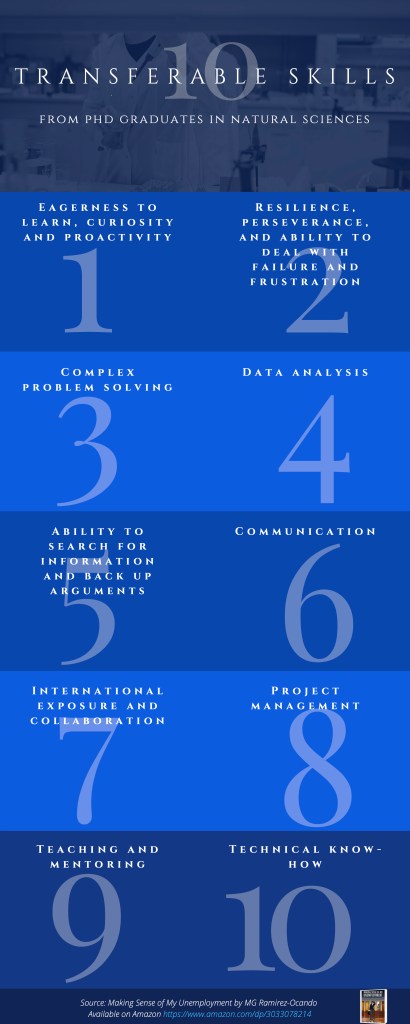
The infographic below summarises ten transferable skills commonly acquired through doctoral research in the natural sciences and highlights why they can be valuable across a wide range of careers.
Key Findings
Doctoral studies help develop a broad range of transferable skills, including:
- Curiosity, initiative and continuous learning.
- Resilience and the ability to cope with setbacks.
- Complex problem solving.
- Data analysis and interpretation.
- Research and evidence-based decision making.
- Communication of complex information.
- International collaboration and cultural awareness.
- Project planning and management.
- Teaching, coaching and mentoring.
- Technical and scientific expertise.
These competencies are valuable not only in academia but also in industry, healthcare, consulting, government and many other sectors.
A Word of Caution
While a PhD develops many valuable transferable skills, graduates should be careful not to assume that the qualification itself will automatically be recognised or valued by every employer. In some sectors, particularly outside academia and research-intensive industries, employers may focus more on practical experience than academic credentials. Some people may even view a doctorate as evidence of spending many years studying rather than gaining commercial experience.
For this reason, PhD graduates often benefit from emphasising the skills and experiences acquired during their doctoral studies rather than relying solely on the title itself. Demonstrating how research experience translates into problem solving, project management, communication and data analysis is often more effective than simply highlighting the qualification.
Education, employability and career development are recurring themes in Making Sense of My Unemployment, which explores how individuals can identify and communicate their value in a changing labour market.
Link to book: https://www.amazon.com/dp/3033078214
 Making Sense of My Unemployment