Link to book: https://www.amazon.com/dp/3033078214
Having the ‘wrong’ passport

Extract from Chapter 9: Challenges of the job search – identity
From: Making Sense of My Unemployment (M.G. Ramirez-Ocando)
It took me many unsuccessful interviews to realize that the employers’ top concern about my nationality was the travel limitations of my visa
There are many aspects to consider when it comes to the challenge of nationality; some are more obvious and critical than others. The most fundamental challenge is obtaining and maintaining the permission to work and live in a foreign country, which is strongly influenced by nationality, among other factors. In Europe in general and Switzerland in particular, immigrants are divided into two main groups: nationals from the European Union/European Free Trade Association (EU/EFTA) member states and third-country nationals (Drittstaatenangehörige, ressortissants de pays tiers) (see Figure 2).

The 26 EU/EFTA member states (including Switzerland itself) constitute what is known as the ‘Schengen area’. Nationals from these member states can freely move across internal country borders without a visa and can easily obtain a residence permit to live and work in another country of the Schengen area (sometimes a permit is not even needed). Moreover, members of the states in the Schengen area can obtain permanent residence in another country of the Schengen area after five years of uninterrupted legal residence.[i] In contrast to nationals from the EU/EFTA, third-country nationals (citizens from all other countries of the world) must obtain a residence permit in order to reside for more than three months in an European country and in order to work there. Each country has established different types of residence permits with different requirements for third-country nationals. In general, these residence permits are granted on the basis of the duration of and the reasons for the stay: study, work or family reunion. There are also residence permits granted as a result of a particular status: diplomatic status, asylum seekers, etc. Switzerland also grants residence permits (visas, Aufenthaltsbewilligungen, permis de séjour) to people of ‘major public interest’, literally meaning famous or rich people.[ii]
In Switzerland, the number of work-related residence permits that can be granted to third-country nationals per year is limited by quota and strictly regulated. The quota depends on the type of permit: temporary residence permit (B permit) or short-term residence permit (L permit). B permits are normally renewed each year (as long as the employment continues) while L permits usually last up to one year. In 2019 the Swiss government established a quota of 4,500 B permits and 4,000 L permits for third-country nationals coming to work in the country.[iii] The limitations imposed by these quotas effectively mean that there is very strong competition for residence permits and that the requirements for the application process (and maintenance of status) are very strict. These types of work-related residence permits are indeed specifically granted to foreigners who are highly qualified and whose profiles cannot easily be found among the current Swiss resident population. Third-country nationals completing their education in Swiss universities also compete for these types of residence permits.[iv] For Swiss employers, the consequence of these regulations is a restricted capacity to hire (talented) employees from third countries.[v] Additionally, residence permits are granted by cantonal authorities and permit holders cannot easily move from one canton to another, which means that third-country national employees are less flexible in terms of job relocation. Third-country nationals married to a Swiss citizen (like me) are granted B permits for ‘family reunion’ (Familiennachzug, regroupement familial). This type of permit is (almost automatically) renewed every two or three years and allows the holder to enjoy a special status. Among other advantages, I can reside in Switzerland without the need for employment, easily change employers and freely move across cantons. Additionally, I can apply for the settlement permit or permanent residence, the C permit, after five years (instead of ten), and soon after also for Swiss nationality.
Although nationals of the EU/EFTA member states have a very clear advantage in comparison to third-country nationals, it must be noted that their special status has been heavily criticized over recent years. In 2014 the majority of Swiss voters (50.3%) supported an initiative demanding limits to the number of foreign workers, including nationals from the members states of the EU/EFTA (Volksinitiative ‘Gegen Masseneinwanderung’, Initiative populaire ‘Contre l’immigration de masse’).[vi] Normally, the Swiss government should have implemented an initiative supported by the majority in this way over the following three years, but in this case the measure would have violated accords with the European Union.[vii]Instead, the government introduced a law in 2018 that granted registered job seekers in Switzerland certain preferences in the job market for areas where the unemployment rate was relatively high (I mentioned this law in the section ‘Not having or using the right network’ in Chapter 8).[viii] Given that 25% of Swiss residents are foreigners and 38% have a migration background (as of 2017), it is understandable that the Swiss have some reservations in relation to unrestricted immigration.[ix] Some of the cities with the highest proportion of foreign labour force are Geneva, Zurich and Basel, where most multinational companies are located.[x] These are also the cities where foreigners are less likely to be challenged by the language.
Aside from the most noticeable hurdles of getting a residence permit and mastering the local language, third-country nationals are also confronted with less obvious challenges during their job search. These challenges are usually ones that very few employers mention openly. It took me many unsuccessful interviews to realize that the employers’ top concern about my nationality was the travel limitations of my visa. Unlike Swiss nationals, I need a visa to travel to many non-European countries, including the US and the UK, two key business regions for international companies. Even though the process of obtaining visas for professional reasons is relatively simple, and visas are then valid for several years, it can take a couple of weeks. Most of the Swiss/European hiring managers I met were unaware of the length or difficulty of the process of obtaining a visa as a third-country national. Nonetheless, they all suspected that a Venezuelan was more likely to run into problems than a European or an American. I first realized how this situation was perceived when discussing my potential first business trip during a job interview. The employer told me that I would have to cover a conference in the US the following month and I (naïvely) mentioned that I would have to start my visa application process right away. My comment immediately made the employer anxious, and he started asking a lot of questions about my travel limitations. After that interview, by coincidence or not, the employer decided to hire a Swiss citizen.
There is another potential challenge associated with my nationality, but I cannot confirm if this was actually a concern for any of the employers I applied to. I can imagine that the fact that my parents live in a country with many problems could create the perception that I was person with ‘heavy baggage’. Indeed, I was (and am) more likely to need to suddenly take time out of work because of family problems that cannot be solved from Switzerland. I was always asked during my interviews if I still had family in Venezuela, and although I believe the question was born out of politeness or curiosity, it is possible that it was not. There is also, of course, the possibility of pure racism, although I personally never had the impression or feeling that I was being treated as inferior due to my nationality. According to a 2018 survey by the Swiss government, 25% of the Swiss population feel uncomfortable at work due to the different characteristics (language, religion, nationality, skin colour, etc.) of ‘others’. Furthermore, the majority of people who feel discriminated against (24% of the respondents) had specifically experienced this discrimination at work or when looking for work.[xi] Factually speaking, the unemployment rate among the foreign population is twice as high as the rate among the Swiss population.[xii]It is likely that the causes of this difference are both objective and subjective. Being aware of the subjective causes can help job seekers to address the potential concerns of employers during the job recruitment process. And it is important to highlight that Swiss nationals can also be discriminated against within their own country. In Robert’s experience, for example, some of the employers he interviewed for expressed the concern that Swiss candidates were ‘not international enough’.
Book available worldwide on amazon.
In Switzerland, it is also possible to buy the book directly from the Author.
[i] Ottavio Marzocchi, ‘Free movement of persons’, European Parliament (November 2019), available at www.europarl.europa.eu/factsheets/en/sheet/147/free-movement-of-persons.
[ii] Jacqueline Badran, ‘Autorisations de séjour en dérogation aux conditions d’admission pour tenir compte d’intérêts publics majeurs’, L’Assemblée fédérale (20 March 2014), available at www.parlament.ch/fr/ratsbetrieb/suche-curia-vista/geschaeft?AffairId=20141014.
[iii] SEM (Secrétariat d’État aux migrations), ‘Le Conseil fédéral fixe les contingents 2019 pour les travailleurs d’États tiers et les prestataires de services des États membres de l’UE ou de l’AELE’ (28 September 2018), available at www.sem.admin.ch/sem/fr/home/aktuell/news/2018/ref_2018-09-280.html.
[iv] Peter Siegenthaler with Jessica Davis Plüss and Dahai Shao, ‘Non-EU graduates struggle with Swiss job access’, Swissinfo.ch (15 May 2019), available at www.swissinfo.ch/eng/labour-market_non-eu-graduates-struggle-with-swiss-job-access/44959126.
[v] Matthew Allen, ‘Cantons demand more access to foreign employees’, Swissinfo.ch (29 August 2017), available at www.swissinfo.ch/eng/worker-visas_cantons-demand-more-access-to-foreign-employees/43478508.
[vi] Bundeskanzlei BK, ‘Vorlage nr. 580 Übersicht’ (9 February 2014), available at www.bk.admin.ch/ch/d/pore/va/20140209/det580.html.
[vii] L’Assemblée fédérale, ‘Contre l’immigigration de masse. Initiative populaire’ (7 December 2012), available at www.parlament.ch/fr/ratsbetrieb/suche-curia-vista/geschaeft?AffairId=20120098.
[viii] Work.swiss, ‘Job registration requirement’.
[ix] FSO, Comment se porte la population issue de la migration en Suisse? Analyses de la qualité de vie en 2017 des personnes issues de la migration (5 November 2019), available at www.bfs.admin.ch/bfs/en/home.assetdetail.10307946.html.
[x] Duc-Quang Nguyen, ‘Defining the 25% foreign population in Switzerland’, Swissinfo.ch (19 November 2017), available at www.swissinfo.ch/eng/migration-series-part-1-_who-are-the-25-foreign-population-in-switzerland/42412156.
[xi] FSO, Survey on diversity and coexistence in Switzerland (VeS): Results 2018 (21 February 2019), available at www.bfs.admin.ch/bfs/en/home/statistics/population/migration-integration/diversity-coexistence-switzerland.assetdetail.7466709.html.
[xii] FSO, Labour market indicators for 2019. Comments on findings for the period 2013–2019 (9 August 2019), available at www.bfs.admin.ch/bfs/en/home/statistics/work-income/surveys/els-ilo.assetdetail.9386090.html.
The Recruitment Process (reactive applications)
Extract from chapter 6
From: Making Sense of My Unemployment (M.G. Ramirez-Ocando)
The content in this extract applies only to reactive applications (those responding to an advertised position), excluding subcontracting and freelance opportunities.
During the time that I was unemployed, I was contacted spontaneously by recruiters/headhunters around 20–25 times, I was called back regarding my reactive applications 53 times and I reached the F2F interview stage in 26 recruitment processes
(…)
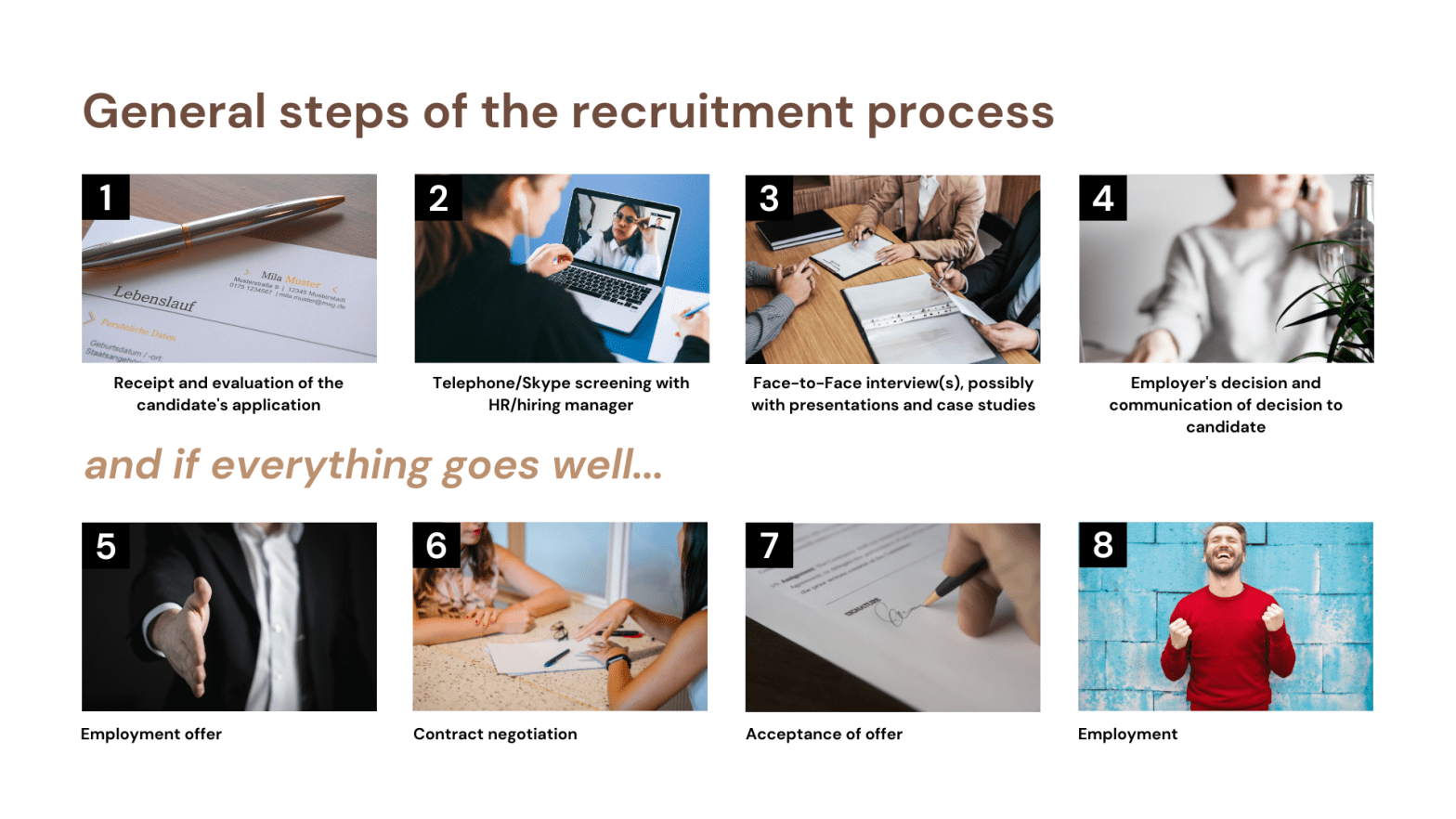
The general recruitment process for most of my interviews in Europe (particularly Switzerland) followed a similar structure:
- Receipt and evaluation of the candidate’s application
- Telephone/Skype screening with HR/hiring manager
- Face-to-face (F2F) interview(s) with presentations/case studies
- Employer decision and communication of decision
And if everything went well:
- Employment offer
- Contract negotiation
- Acceptance of offer
- Employment
Whereas all of the first three steps focused strongly on questions related to experience and personality, step 3 often also included some sort of practical exercise showcasing professional expertise. Steps 5–8, of course, only happened when I actually received an offer (…). The time between each step was highly variable. For example, there were companies that only contacted me for the first time two to three months after I had sent my application, whereas others contacted me the day after. Similarly, there were companies that communicated their final decision one or two months after the last interview, whereas others did so within days. In general, the recruitment process of big international companies took longer than that of smaller (local) companies.
For positions managed through external recruitment/placement/employment agencies (Arbeitsvermittlung, agence de placement), there were some variations to the structure described above. Companies often use external recruitment agencies to outsource the first steps of the recruitment process: finding relevant talent and doing the first filtering process. Recruitment agencies can perform very similar tasks to those usually done by internal HR personnel, or they can proactively reach out to suitable candidates and simply serve as a mediator for the first introduction to the hiring company. Some of the best-known recruitment agencies in Switzerland are Manpower, Adecco and Kelly (…).
(…)
Book available worldwide on amazon.
In Switzerland, it is also possible to buy the book directly from the Author.
Book advice for newcomers in Switzerland

THE EXPERT GUIDE TO YOUR LIFE IN SWITZERLAND
Bergli Books
There is always a lot of new information to look for (and learn) when moving to a new country. Google is an excellent tool to start the search for the common questions “How do I?” “Where do I?” “When should I?.” Things can, however, get very complicated when the critical information is only available in an unmastered foreign language.
The new book from Bergli “The Expert Guide to your life in Switzerland” is the perfect way for newcomers to learn about the country. Bergli is an imprint of the Schwabe Verlagsgruppe, specializing in books about Switzerland and the international people living here. The Expert Guide is its most recent book and it can not be better described as with its own tittle.
Here is what I like most about the book:
- It is very nicely designed, and this makes it very easy and attractive to read. There are a lot of pictures, call-out boxes with tips and several comparison tables.
- It does not need to be read in any specific order; every chapter can be understood without reading the previous ones. The book is organized in 18 sections dealing with various aspects of life in Switzerland: family, health, money, travel, social life, etc.
- Every chapter is written by an expert on the subject, including Diccon Bewes, author of the best-seller “Swiss Watching.”
- There are very useful tips: from an overview of the different train tickets and must-see places, to the types of childcare options available and the ways to save costs in healthcare and taxes.
- It includes references to key organizations/platforms (e.g., associations that defend the tenant’s interests, platforms for comparisons, for finding a place to rent or to buy, for finding a babysitter, etc.)
- There are important terms written with their equivalent translations in French and German (e.g. witholding tax, impôt à la source, Quellensteuer)
There are, however, a couple of things I missed. I would have liked (1) a mini-test at the end of each chapter to recap all the content and (2) a proper end for the book. It would have been great to read a joint statement from all authors at the end.
All in all, an excellent book for us expats living in this incredibly beautiful country.
You can find out more about the book here
Ten Motivations for Overworking
Link to book: https://www.amazon.com/dp/3033078214
 Making Sense of My Unemployment